Showing posts with label Grieve Ovens. Show all posts

Wednesday, February 10, 2016

Process Ovens Over 40 years Old


Safety Updates for Older Ovens.


Most Process ovens made over 40 years ago did not include an excess temperature controller or separate heating element contactors to protect the oven from overheating if the main temperature controller or contactors fail. 
 Any ovens like this should not be used until this safety equipment is installed.  Failure to install this safety equipment could result in the oven overheating and a fire that could result in oven damage, loss of the product load, building damage and injury to personnel.
 

A field kit to add the excess temperature controller and separate contractors should be ordered from the MFG.

The excess temperature controller and separate contactors are now standard equipment on all Grieve ovens.  Also standard is a recirculating blower airflow safety switch to shut down the oven heat if the recirculating blower fails.  This is a pressure differential switch that senses the pressure created when the blower wheel is turning.  This switch protects the oven heating elements by preventing them from heating when air is not being recirculated over them.  A field kit for installation of the recirculating blower airflow safety switch should be purchased from the oven MFG.


When installing new safety equipment it can be a good idea to add other new electronics to the oven for better performance.  New electronics could be a digital temperature controller, programmable digital temperature controller, new thermocouples or a digital timer.  Grieve can provide a field kit to add a digital temperature controllers as well as and a field kit for a digital shut down timer. For electric Ovens new elements can be ordered as well along with pin and sleeve disconnect switches for added electrical safety for personnel. We can provide Gas meters for gas ovens to measure gas flow at the oven and shut the oven down in a dangerous situation.

Grieve's field kits include installation instructions, wiring diagram showing items to be removed, wiring diagram showing items to be added and revised wiring diagram for your records.  Our kits will be based on how the ovens were constructed when they left our factory.  If there have been changes made to the oven in the field they will not be included in our revised wiring diagram.   


Grieve will provide all parts except for standard wire, conduit and conduit fittings.  These items are better provided in the field as necessary to connect the components being added.  Conduit would only be required for the air flow safety switch as the other items are mounted in the oven control panel.

Please contact Anderson-Bolds with the oven serial number, job # and model number all of which can be found on the name plate of the oven.  We can also provide new wiring schematics for old ovens and instruction manuals.  Grieve and Anderson-Bolds want our products to be operated in the safest manner possible. 


Contact Anderson-Bolds at:
216-360-9800 
grieve@anderson-bolds.com


Thursday, October 22, 2015

Grieve Universal 850 Degree Oven

Grieve 2-Compartment Universal Oven

Oven No. 979 is a 85O F (454 C), electrically heated, universal-style
oven from Grieve, currently used for various machine shop heat
treating operations. Workspace dimensions of this oven measure
36" W x 36" D x 36" H in each of the two comparrments. 24 kW
(12 kW per zone) are installed in lncoloy-sheathed tubular elements
to heat the dual oven chambers, while a 6OO-cfm, 1/2-hp
recirculating blower provides front-to-back universal airflow to the
workload in each compartment.
This Grieve universal oven features 6" insulated walls, aluminized
steel exterior with enamel finish, Type 304 stainless steel
interior, double doors, three roller shelves rated for 200-lb loading,
five nickel plated, 100-lb capacity shelves in the top chamber
three nickel plated, 100-lb capacity shelves in the bottom
chamber and an integral leg stand.
No. 979 controls include a digital indicating temperature controller
for each compartment, recirculating blower airflow safety
switches, a 10" diameter circular chart recorder for each compartment
to record part temperature and manual reset excess

temperature controllers with separate contractors.


For more information visit Grieve at Anderson-Bolds or call 216-360-9800

Thursday, December 18, 2014

GRIEVE NBS-400 Bench Oven - Class A

Class A Oven by Anderson-Bolds and Grieve Corporation


Model NBS-400 meets the requirements of OSHA and National Fire Protection Association Standard 86 for Class A ovens. Not for use in hazardous locations as defined in the National Electric Code.

These rugged bench ovens are designed for a wide variety of industrial heat processing applications including those where flammable solvents or vapors will be present in the oven.

STANDARD FEATURES

— Recirculating blower
— 304 stainless steel interior
— Incoloy sheathed tubular heating elements
— Silicone rubber door gasket
— Analog, thermocouple actuated, temperature controller
— Adjustable, thermocouple actuated, manual reset excess
     temperature interlock
— On-off switch
— Red pilot light indicates heater operation
— Sturdy steel construction
— Brushed stainless steel exterior
— 6 lb/cf density industrial rockwool insulation
— Built-in baffles prevent radiant heat
— Fully factory tested
— 1 year limited warranty

MODEL NBS-400
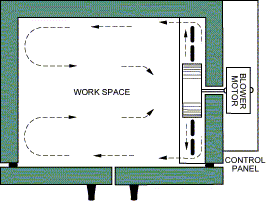
Fan forced recirculation of heated air throughout 7 cubic foot work space at temperatures to 400°F. Includes two (2) removable nickel plated wire shelves easily adjustable on 2" centers. Holds a maximum of seven (7) shelves. Includes safety equipment required when flammable solvents or vapors are present in an oven.

Grieve NBS Class A Bench Oven


STANDARD EQUIPMENT 
Standard Electrical Characteristics
— 208 volts, 1-phase, 60 Hz
— 230 volts, 1-phase, 60 Hz
— Other electrical characteristics available

MODEL NBS-400
Completely wired control panel assembled on the oven enclosing the temperature controller, manual reset excess temperature interlock, pilot light to indicate when heaters are energized and on-off switch. Includes additional safety equipment required by OSHA and NFPA 86 for Class A ovens. Will handle a maximum of 3 ounces (0.024 gallons) of flammable solvents or vapors per batch at a maximum temperature of 400°F. 


Manual Reset Excess Temperature Interlock
Turns off heat if oven exceeds 400°F.

Back-Up Heating Element Relay
Turns off oven heat on excess temperature controller actuation in the
event of failure of the primary heating element relay


35 CFM Separately Powered Forced Exhauster
Provides safety ventilation. Exhaust outlet 4" diameter.


Exhauster Air Flow Safety Switch
Turns off oven heat if exhauster fails


Recirculating Blower Air Flow Safety Switch
Turns off oven heat if recirculating blower fails


Purge Timer
Provides time delay to allow exhauster to pull four oven volumes of
air through the oven prior to turning oven heat on


Contact Anderson-Bolds for all your Electric Processing needs.
We can enhance your production.
216-360-9800

Friday, November 8, 2013

Grieve Class A Ovens for Solvents/Vapors

Grieve Oven Corporation makes Class A Bench Ovens - Anderson-Bolds

CLASS A ovens are ovens for processing applications that involve solvents and vapors that are harmful to workers.

Grieve Model NBS Bench Oven(see below)


OSHA requires ovens processing flammable solvents or vapors to conform to the National Fire Protection Association Standard 86 (1999). NFPA 86 defines ovens for these applications as Class A ovens. In order to keep flammable vapor concentration at safe levels, Class A ovens include specific items of additional equipment to provide safety ventilation. This additional equipment is sized based on the volume of solvent being evaporated and the maximum operating temperature.
Safety ventilation also depends on the processing method. In batch processes, where all parts heat up at the same time, the flammable vapor concentration in not constant. As the work temperature rises the vapor concentration also rises to a peak value and then tapers off. This requires greater safety ventilation than in continuous processing where parts are heated sequentially and the vapor concentration remains constant.
Direct - fired gas ovens include Class A equipment to remove products of combustion. Combustion venting is sized at 183 standard cubic feet per minute of exhaust per 1,000,000 BTU/HR of burner rating. Depending on the amount of flammable solvent processed, a larger powered forced exhauster may be required to handle both combustion venting and safety ventilation.


SIZING SAFETY VENTILATION AND HEAT LOSS

Safety ventilation exhaust provides a supply of fresh air to ensure that the flammable vapor concentration in the oven remains below the Lower Flammable Limit (LFL) at all times. When more than one flammable solvent is present, safety ventilation is based on the solvent requiring the greatest amount of ventilation
Direct-fired gas heated ovens require combustion venting which must be added to the safety ventilation exhaust rate.
Combustible solids or substrates do not require safety ventilation unless flammable constituents are released when these materials are heated. Powder coating curing ovens require safety ventilation to be calculated as though 9 % of the powder weight is being evaporated as the flammable solvent Xylene.
Exhaust rates must be corrected for maximum operating temperature. As oven operating temperature increases, greater exhaust is required to compensate for the decrease in air density. Similarly, at altitudes over 1000 feet, the exhaust rate must be increased to compensate for lower air density.

 Batch Processing

For batch oven applications below 250° F, the safety ventilation exhaust rate must be sized at a rate of 440 standard cubic feet per minute for each gallon of solvent introduced into the oven in a batch. Between 250° F and 500° F, this exhaust rate must be increased by a multiplier of 1.4. Above 500° F, the 1.4 multiplier is not appropriate and a correction factor must be determined by tests run by the solvent manufacturer.
In addition, for solvents where the volume of air necessary to render 1 gallon of solvent barely explosive exceeds 2640 standard cubic feet, the exhaust rate must be increased. The increase is made by multiplying by a factor created by taking the volume of air necessary to render 1 gallon of solvent barley explosive and dividing it by 2640 standard cubic feet.
Safety ventilation and heat loss for a batch process can be estimated using the chart below. This chart shows the exhaust rate and heat loss for 0.1 gallon of solvent. The data is based on a solvent with LFL of 2640 standard cubic feet and on an installation located below 1000 feet in altitude.


 Continuous Processing

For continuous processing ovens, the safety ventilation exhaust rate must be sized to keep the concentration of solvent in the oven atmosphere below 25% of the Lower Flammable Limit (LFL) after the LFL has been corrected for operating temperature.
The specific gravity and vapor density of the solvent are used to determine the gallons of vapor created by 1 gallon of evaporated solvent. Combining this information with the Lower Flammable Limit determines the air volume rendered barely explosive when 1 gallon of solvent is evaporated. This is multiplied by a factor of 4 to limit the vapor concentration to 25% of the Lower Flammable Limit.

The safety ventilation exhaust rate is obtained by multiplying this volume by the number of gallons of solvent evaporated per minute.


Safety ventilation and heat loss for a continuous process can be estimated using the chart below. This chart shows the exhaust rate and heat loss for 0.1 gallon of Xylene. Xylene has specific gravity of 0.88 (Water = 1) and vapor density of 3.7 (Air = 1). The Lower Flammable Limit by volume is 0.9%. The amount of air rendered barely explosive per gallon evaporated is 2899 standard cubic feet. The calculated exhaust required per gallon of Xylene evaporated in continuous processing is 193 standard cubic feet per minute.

GRIEVE MODEL NBS Class A Bench Oven  (Picture Above)

Model NBS-400 meets the requirements of OSHA and National Fire Protection Association Standard 86 for Class A ovens. Not for use in hazardous locations as defined in the National Electric Code.
These rugged bench ovens are designed for a wide variety of industrial heat processing applications including those where flammable solvents or vapors will be present in the oven.
Fan forced recirculation of heated air throughout 7 cubic foot work space at temperatures to 400°F. Includes two (2) removable nickel plated wire shelves easily adjustable on 2" centers. Holds a maximum of seven (7) shelves. Includes safety equipment required when flammable solvents or vapors are present in an oven. 
STANDARD FEATURES
— Recirculating blower
— 304 stainless steel interior
— Incoloy sheathed tubular heating elements
— Silicone rubber door gasket
— Analog, thermocouple actuated, temperature controller
— Adjustable, thermocouple actuated, manual reset excess
     temperature interlock
— On-off switch
— Red pilot light indicates heater operation
— Sturdy steel construction
— Brushed stainless steel exterior
— 6 lb/cf density industrial rockwool insulation
— Built-in baffles prevent radiant heat
— Fully factory tested
— 1 year limited warranty
Standard Electrical Characteristics
— 208 volts, 1-phase, 60 Hz
— 230 volts, 1-phase, 60 Hz
— Other electrical characteristics available
Completely wired control panel assembled on the oven enclosing the temperature controller, manual reset excess temperature interlock, pilot light to indicate when heaters are energized and on-off switch. Includes additional safety equipment required by OSHA and NFPA 86 for Class A ovens. Will handle a maximum of 3 ounces (0.024 gallons) of flammable solvents or vapors per batch at a maximum temperature of 400°F. 

Manual Reset Excess Temperature Interlock
Turns off heat if oven exceeds 400°F.

Back-Up Heating Element Relay
Turns off oven heat on excess temperature controller actuation in the
event of failure of the primary heating element relay

35 CFM Separately Powered Forced Exhauster
Provides safety ventilation. Exhaust outlet 4" diameter.

Exhauster Air Flow Safety Switch
Turns off oven heat if exhauster fails

Recirculating Blower Air Flow Safety Switch
Turns off oven heat if recirculating blower fails

Purge Timer
Provides time delay to allow exhauster to pull four oven volumes of
air through the oven prior to turning oven heat on


216-360-9800 / 614-885-3933 / 513-528-5680
grieve@anderson-bolds.com


Cleveland - Cincinnati - Columbus
Ohio - West Virginia - Kentucky

Saturday, October 5, 2013

Grieve Walk-In Batch Ovens

Anderson-Bolds is the Ohio and Kentucky Rep for  GRIEVE  Ovens

Use Our Grieve Oven Application Data Sheet or call 216-360-9800


Grieve Walk-In Ovens

Grieve Walk In Ovens for paint baking, drying, preheating, annealing or any other heat processing of large or numerous parts at temperatures to 750°F. Oven size conveniently accommodates materials handling equipment. Choice of either combination or full horizontal air flow in either rear or top mounted heat chamber configurations. Designed and constructed for long, hard, continuous use.


STANDARD FEATURES

UL ul1.gif LISTED CONTROL PANEL 
Standard Truck Ovens from Grieve meet the requirements of National Fire Protection Association Standard 86, Industrial Risk Insurers, Factory Mutual and OSHA standards. For some applications, such as those involving flammable solvents or hazardous locations, the above organizations require additional safety devices.
Controls
— Digital, microprocessor based, thermocouple actuated, indicating temperature controller
— Modulating burner on gas ovens
— Motor control push buttons and on-off heat switch
— LED pilot lights
Safety Equipment — Electric Oven
— Adjustable, thermocouple actuated, manual reset excess temperature interlock
— Separate heating element control contactors
— Recirculating blower air flow safety switch
Safety Equipment — Gas Oven
—Adjustable, thermocouple actuated, manual reset excess temperature interlock
—Electronic flame safeguard protection
—Powered forced exhauster for combustion venting
—Exhauster air flow safety switch
—Recirculating blower air flow safety switch
—Two pilot safety shutoff valves with leak test stations
—Two main safety shutoff valves with leak test stations (Industrial Risks Insurers vent valve only provided on specific request)
—Valve position indicator on main safety shutoff valves
—Over 400,000 BTU/HR safety shutoff valve interlocked with
purge timer
—Purge timer
—High gas pressure switch
—Low gas pressure switch
Construction
—Choice of air flow patterns
—Adjustable opposed louvers on full coverage supply and return
duct work
—Choice of rear or top heat chamber
—Available with doors at each end
—Choice of floor configurations, flat plate, insulated floor, truck
wheel guide tracks
—Exceptionally heavy duty doors
—Aluminized steel interior
—Aluminized steel exterior with enamel finish
—High temperature door gasket with stainless steel spring insert
—6 lbs/cf density industrial rockwool insulation
—Brushed stainless steel control panel face
—1 year limited warranty
Every oven fully assembled and individually factory tested 

STANDARD EQUIPMENT
All Models
— 208 volts, 3-phase, 60 Hz
— 230 volts, 3-phase, 60 Hz
— 460 volts, 3-phase, 60 Hz
— Other electrical characteristics available

Aluminized steel interior. Carbon steel structural members and steel plate painted with high temperature aluminum paint. Trilite Green enamel painted aluminized steel exterior. 

Two Air Flow Patterns Available
Combination air flow for random shapes and sizes or for large bulky objects where heated air can move upward, around and through the load. Horizontal air flow for applications where heated air must move sideways to pass through a load such as trays or flat sheets. See circulation diagrams below.

Horizontal Air Flow
Heated air is blown horizontally across the work space between full coverage duct work. For shelf truck loading applications with densely loaded shelves, solid bottom trays, or flat sheets where heated air can only pass sideways above and below each level. Also used on oven floor or loaded on a flat bed truck. 

Combination Air FlowHeated air is provided from full coverage supply duct work at each side of the work space and sweeps upward through the load to a return duct at the top of the work space. Used in most shelf truck loading applications where sufficient shelf area is left open to allow vertical air movement upward through the loaded truck. Ideal for large parts placed directly on oven floor or loaded on a flat bed truck.


Two Oven Configurations Available
Rear heat chamber for easy handling, low profile equipment. Top mounted heat chamber to minimize factory floor space occupied or to allow installation of doors at each end. Doors on front and rear allow for pass through operation or for loading from both ends.

To facilitate shipping and handling, top mounted heat chamber ovens are available with removable heat chambers. These ovens are fully assembled and tested. They are then sectioned and match-marked for easy reassembly at destination by customer.
Ovens come standard with steel plate floor and doorsill which oven doors seal against. If specified, doorsill can be eliminated and doors provided with drag seals. Up to 6' wide work space, plate floor is 1/8" thick. Wider ovens have 1/4" plate floor. Provisions for customer installed insulated floor are included. Optional factory installed insulated floor is available. See Bulletin WI-513.
Optional truck wheel guide tracks for loading equipment are available. Guide tracks can be installed on steel plate floor, recessed into insulated floor, or installed on top of insulated floor. See Bulletin WI-513.
Optional loading trucks specifically designed for use in each oven are available. Loading trucks come in shelf loading models with removable shelves or as heavy duty flat bed models with grating surface. See Bulletin WI-513.
Electric Models
Each features completely wired, side access UL listed control panel enclosing terminals for incoming power, temperature controllers, push buttons and pilot lights. Motor starter and heating element contactors electrically interlocked to shut off heaters if power to blower is interrupted and to permit operation of blower without heat for cooling. Incoloy sheathed tubular heating elements.

Gas Models
—1,000 BTU natural gas at 6" water column pressure: 
1" NPT inlet to 350,000 BTU/HR; 
1-1/4" NPT to 1,200,000 BTU/HR
— Other gas characteristics available

Control panel as detailed above and safety devices as listed on the front of this bulletin. A 325 CFM powered forced exhauster is included up to 800,000 BTU/HR; at 1,200,000 BTU/HR a 650 CFM exhauster is included. Both exhausters have 6" outlets. Automatic pre-ignition purge period and push button electric ignition contributes to ease of operation. Modulating gas burner is protected with electronic flame safety relay.


grieve@anderson-bolds.com

216-360-9800