Showing posts with label immersion Heaters. Show all posts

Sunday, March 31, 2019

Maximize Electric Heater Performance

Ten Tips to Maximize Heater Performance


Electric Heating elements are very durable and can last a png time with some preventative care for the elements. In the industrial world some heaters are put ito abusive environments so using some of these tis could add life to your electrical heating elements and heaters. 

Contact Anderson-Bolds HERE!


Watlow Firebar Elements


Many plant engineers do not give much thought to the heaters operating within their processes and applications - unless those heaters fail, require significant maintenance or cause other problems. Unfortunately, heaters play an integral role in many applications. Therefore, heater problems can easily snowball and lead to much larger headaches.

Following a few simple guidelines will not only reduce the likelihood of heater-related issues, but can actually have a significant positive impact on the efficiency of systems and reduce maintenance requirements and costs. Below are 10 ways to maximize a heater's service life and performance.

Tip 1: Guard against heater contamination

Contamination is the most frequent cause of heater failure (see images). As heaters expand and contract during cycling, they often draw in organic or conductive materials. This can lead to an arcing failure between individual heater windings or between heater windings and the electrically grounded outer heater sheath. When allowed to collect at the lead end of a heater, contaminants can also cause electrical shorts between power pins or terminals. Therefore, it is important to keep lubricants, oils, low-temperature tapes or processing materials out of contact with the lead end of the heater. Employing seals will help.

Tip 2: Protect leads and terminations from high temperatures and excessive movement

Standard fiberglass-insulated lead wire may be used in applications with ambient temperatures up to approximately 260°C (500°F). If a lead is exposed to higher temperatures, high-temperature lead wire or ceramic bead insulation should be used. An unheated section of the heater, extending away from the heated region of the system, enables the leads to run at a beneficially cooler temperature.
When heaters are mounted in moving machinery, it is essential to anchor the leads to prevent them from being damaged. A lead protection option should be specified and used for optimum protection against lead damage.

Tip 3: Heater selection and sizing are important

A heater's wattage should be matched as closely as possible to the application's actual load requirements to limit ON/OFF cycling (see tip 6). For fitted-part applications, specify the hole or an alternative application feature size to ensure an optimal fit between the heater and application feature. A tight fit minimizes air gaps and reduces the instances of hot spotting.

Tip 4: Ground the equipment

It is common sense and safe practice to electrically ground all equipment on which the heater is used. Grounding equipment helps protects plant and personnel in the event of an electrical failure in the heating system.

Tip 5: Regulating voltage ensures the rated heater voltage matches voltage supply

It is essential to ensure a heater's rated voltage matches the available voltage supply because wattage increases (or decreases) at the square of the change in voltage applied to a heater. For example, if a heater is rated for 120V/1000W and is connected to a 240V supply, it will generate four times the rated wattage output or 4000W. This will cause a heater to fail relatively quickly and can also cause significant damage the attached equipment.

Tip 6: Prevent excessive heater cycling

Excessive temperature cycling is very detrimental to the life of a heater. The most detrimental is the cycle rate that allows full expansion and contraction of the heater resistance wire at a high rate (30 to 60 seconds' power ON and power OFF). This causes severe stress and oxidation of the resistance wires inside a heater. A bad temperature cycle is typically found when thermostats are used. Thermostats respond slowly to temperature changes and have large switch ON/OFF temperature differentials. An improvement, but a somewhat more expensive solution, is to use ON/OFF or PID controllers with mechanical relays. It is crucial to not switch the frequency or cycle time too rapidly (somewhere between 3 to 10 seconds), because the relay contacts can wear out quickly.
The most effective way to minimize heater element temperature cycling, and the most expensive solution, is to use solid state relays (SSRs) and SCR power controllers coupled to PID temperature controllers. This combination provides the best performance for both your thermal system as well as for the heater itself. Solid state switching devices cycle power to the heater very rapidly (from one second with a SSR, down to milliseconds with phase-angle fired SCRs). This fast-power cycling dramatically reduces heater element wire temperature excursions and substantially extends heater life.

Tip 7: Ensure that the sheath material and watt density ratings are compatible with the material being heated

This is absolutely critical to ensure long heater life and healthy processing equipment. When heating solids, such as metals, the operating temperature and heater-to-part fit drive sheath material and watt density choices. Carbon steels, aluminum, silicone rubber sheath materials are fine for lower temperatures (a few hundred degrees). However, as temperatures increase beyond this point, sheath material choices become limited to galvanized or stainless steels and other higher temperature metal alloys. As temperature also increases, the watt density must decrease accordingly to prevent internal resistance wires from oxidizing quickly and failing prematurely. A good heater-to-part fit ensures proper heat transfer and does not force the resistance wires to overheat.

When heating gases, the operating temperature and flow rates dictate what sheath material and watt density can be used. For example, you can run higher watt densities when heating hydrogen versus nitrogen, but hydrogen requires Alloy 800 sheaths, whereas 304 Stainless Steel will work for many nitrogen applications.
Increasing flow and turbulence across the heater elements means better heat transfer, which raises watt density values. For liquid heating, the prime driver for materials and watt density selection is the fluid material and flow rate. Water can easily handle 42.52 to 70.87W/cm2 (60 to 100W/in2) using a copper sheath, whereas a 50/50-water/glycol mix can only handle 21.26 W/cm2 (30 W/in2) and must use a steel sheath.

Tip 8: Mount immersion tank heaters horizontally near the tank bottom

Heaters should be placed horizontally and near tank bottoms to maximize convective circulation. Vertical mounting is only advisable when limitations, such as space restrictions, prohibit horizontal placement. Regardless of whether a heater is mounted horizontally or vertically, it is essential to place it high enough to avoid any sludge and debris buildup in the bottom of the tank. Likewise, for both mounting methods, the entire heated length of the heater must be immersed at all times - one reason vertical mounting is rarely recommended. It is also important to avoid placing heaters in restricted spaces that limit convective flow and/or where free boiling or steam traps can occur.

Tip 9: Prevent build-up and sludge on the heater elements

Scale, coking and sludge build-up on heater sheaths must be minimized. Any accumulation should be periodically removed or at least minimized, to avoid inhibiting heat transfer to the liquid. Periodic cleaning prevents heater elements being forced to operate at higher temperatures, which can lead to early heater failure. Extreme care should also be taken to avoid getting silicone lubricant on the heated section of a heater. Silicone will prevent the "wetting" of the sheath by the liquid, act as an insulator, and possibly cause the heater to fail.

Tip 10: Ensure proper, tight temperature control and safety limit protection

Matching the appropriate temperature control system to the heater is imperative to strong heater performance and life. Each process application should, at the very least, include a process temperature sensor (to sense the material being heated) and a limit sensor (to sense the heater sheath temperature). The process sensor should be directly immersed into the material to be heated, or snugly inserted into a thermowell inside the fluid itself. For safety reasons, two separate control systems should be used - one for process temperature control and one for high limit control. PID type process temperature controllers offer more stable control and faster response than ON/OFF switching controls or thermostats. The trade off is that PID control is often more expensive than ON/OFF types and not always necessary for applications that do not require highly accurate temperature control.


Anderson-Bolds
216-360-9800

Watlow Heaters and Controls - Process Technology - Chromalox - Process Heat

Saturday, October 5, 2013

Watlow Fire Bar Heaters and Elements

Anderson-Bolds sells Watlow Fire Bar Heaters and Elements


Watlow’s FIREBAR heaters with flat surface technology provide faster heat-up and recovery times than standard round tubular heaters. Their unique shape minimizes coking and oil degradation, and enhances the flow of the oil past the element’s surface, helping to pull heat away from the heater sheath. The heater lasts longer because it runs at a significantly lower sheath temperature than an equal watt density round tubular. This also prolongs the life of the oil or shortening and reduces costs from frequent changing.
Because of its design and geometry, a FIREBAR heater will heat viscous fluids from ambient temperature faster than tubular elements with the same wattage and at a lower sheath temperature. Other advantages of the FIREBAR heater’s flat surface technology include:

Buoyancy force – The flat geometry of the FIREBAR heater creates the physical principle of buoyancy force that lifts the oil into the work zone and makes this product superior to round tubular heaters.

Smaller dimension normal to the flow – The element’s width or thickness is 0.235 in. (5.9 mm). Compared to a 0.430 in. (11 mm) round tubular element, this relative thinness further reduces drag on liquids or gases flowing past the heater, resulting in better heat transfer, quicker heat up and lower sheath temperature.

Reduced watt density - The surface area per linear inch of a FIREBAR is 70 percent greater than the 0.430 inch (11 mm) diameter round tubular element. The FIREBAR, is nearly 13 percent greater. This translates into longer heater life with optimum performance.

The lower profile design of the 58-inch FIREBAR heater packages 13 percent greater wattage than an equal length, commonly used tubular heater. This heater is available in two-coil construction, while the one-inch FIREBAR heater offers three-coil, three-phase construction.
Perfect for oil immersion applications, such as open and pressure fryers or smaller countertop fryers.


FIREBAR Specifications

Dimensions: one-inch FIREBAR: 1.010 inch (25.7 mm) height, 0.235 inch (5.9 mm) thickness; 58-inch (16mm) FIREBAR: 0.650 inch (16.5 mm) height, 0.235 inch (5.9 mm) thickness

Watt densities:

One-inch (25 mm) FIREBAR, double-ended, up to 120 W/in2 (18.6 W/cm2), single-ended, up to 60 W/in2 (9.3 W/cm2); 58-inch (16mm) FIREBAR, double-ended, up to 90 W/in2 (13.9 W/cm2), single-ended, up to 80 W/in2 (12.4 W/cm2)

Incoloy® sheath temperatures to 760°C (1400°F)
304 stainless steel sheath temperatures to 650°C (1200°F)
Three resistance coil design, available in 1- or 3-phase
on FIREBAR only
Amperages on FIREBAR to 48 amps per heater or
16 amps per coil; amperages on FIREBAR to 25 amps per heater on single-ended and 32 amps per heater or 16 amps per coil on double-ended
Mounting options: mounting brackets, water-tight bulkheads, water-tight double leg threaded fitting
UL® and CSA component recognition, CE (Declaration of Conformity) available on request


216-360-9800

Monday, September 23, 2013

Watlow Screw Plug Immersion Heaters for Clean water

 Watlow Immersion Heaters by Anderson-Bolds

Watlow's immersion heaters are designed primarily for direct immersion in liquids such as water, oils, solvents and process solutions, molten materials as well as air and gases. By generating all the heat within the liquid or process, these heaters are virtually 100 percent energy efficient. These versatile heaters can also be formed and shaped into various geometries for radiant heating and contact surface heating applications. UL® and CSA component recognized elements are available.


Watlow Screw plug immersion heaters are ideal for direct immersion heating of liquids, including all types of oils and heat transfer solutions.
Available in a variety of sizes, Watlow® screw plug immersion heaters feature both WATROD™ round and FIREBAR® flat tubular elements.
Heating elements are hairpin bent and either welded or brazed into the screw plug —depending on element sheath and plug material compatibility.
General purpose terminal enclosures are standard; with optional moisture resistant, explosion resistant and explosion/moisture resistant enclosures available to meet specific application needs.
Optional thermostats provide convenient process temperature regulation to the screw plug immersion heater.


Watlow Screw Plug Electric Immersion Heaters with a 1.25 inch Plug for Clean Water with General Purpose Terminal Housing (NEMA 1).  Heaters designed for use in clean water with a high watt density.  Heaters have Alloy 800 elements with a brass screw plug.  Voltages from 120 to 480 and wattages from .5 kw to 6 kw.  Available with or without an integral Thermostat.

Watlow Screw Plug Electric Immersion Heaters with a 1.25 inch Plug for Clean Water with moisture resistant/explosion resistant Terminal Housing (NEMA 4/7).  Heaters designed for use in clean water with a high watt density.  Heaters have Alloy 800 elements with a brass screw plug.  Voltages from 120 to 480 and wattages from .5 kw to 6 kw.  Available with or without an integral Thermostat. Watlow BDN and BEN Series heaters.

Watlow 2 inch Brass Screw Plug Electric Immersion Heaters for Clean Water with General Purpose Terminal Housing (NEMA 1) Heaters designed for use in clean water with a high watt density.  Heaters have Alloy 800 elements with a brass screw plug.  Voltages from 120 to 480 and wattages from 2 kw to 15 kw.  Available with or without an integral Thermostat.  Watlow BGN series Heaters.

Watlow BGN711C6S7A, Immersion Heater, 3 kw, 120/240 VAC/1 phase, Alloy 800 Elements, 100-550 Tstat

Watlow BGN721C3S, Immersion Heater, 9 kw, 240 VAC/3 phase, Alloy 800 Elements

Watlow 2 inch Screw Plug Electric Immersion Heaters for Clean Water with Moisture/Explosion Proof Terminal Housing (NEMA 4 / 7)  Heaters designed for use in clean water with a high watt density.  Heaters have Alloy 800 elements with a brass screw plug.  Voltages from 120 to 480 and wattages from 2 kw to 15 kw.  Available with or without an integral Thermostat.  Watlow BGN series heaters.

    Watlow BGN78C7C, Immersion Heater, 2 kw, 240/480 VAC/1 phase, Alloy 800   Elements

   Watlow BGN715C5C, Immersion Heater, 6 kw, 480 VAC/3 phase, Alloy 800 Elements

Watlow 2.5 inch Screw Plug Electric Immersion Heaters for Clean Water with General Purpose Terminal Housing (NEMA 1) Heaters designed for use in clean water with a high watt density.  Heaters have Alloy 800 elements with a brass screw plug.  Voltages from 120 to 480 and wattages from 3 kw to 38 kw.  Available with or without an integral Thermostat.  Watlow BLN series heaters.

    Watlow BLN77L1S, Immersion Heater, 3 kw, 120 VAC/1 phase, Alloy 800 Elements

    Watlow BLNF33L5S, Immersion Heater, 38 kw, 480 VAC/3 phase, Alloy 800 Elements

Watlow 2.5 inch Screw Plug Electric Immersion Heaters for Clean Water with Moisture/Explosion Proof Terminal Housing (NEMA 4/7) Heaters designed for use in clean water with a high watt density.  Heaters have Alloy 800 elements with a brass screw plug.  Voltages from 120 to 480 and wattages from 3 kw to 38 kw.  Available with or without an integral Thermostat.  Watlow BLN series heaters.

    Watlow BLN710L3C5A, Immersion Heater, 4.5 kw, 240 VAC/3 phase, Alloy 800 Elements, 60-250 Tstat

   Watlow BLN720L3C7A, Immersion Heater, 9 kw, 240 VAC/3 phase, Alloy 800 Elements, 100-550 Tstat
    

If you need help to pick out a heater, please use our Immersion Heater Design Form.

Anderson-Bolds has been helping people and companies with electric heaters for over 75 years.

www.anderson-bolds.com    216-360-9800

Sunday, January 6, 2013

Copper Sheath Immersion Heaters

Screw Plug Immersion Heaters with Copper Sheath for Heating Water.

Anderson-Bolds has been providing electric heating elements for heating water since 1934.  The first choice in heaters for industrial accounts to heat water tanks are screw plug electric immersion heaters.  The Screw Plug is easily installed via an NPT fitting in the tank wall.  The heater should be located near the bottom of the tank as when the heater is on it creates a convection within the tank.  The heater heats by conduction, or contact with the media.  But as water is heated or warmed by the immersed elements the warm water rises to the top of the tank.  The water below the heating element in a tank will not be heated.  Copper is the preferred sheath material for heating water.  Copper has the best heat transfer capability but also the lowest max temperature of about 750 degrees F.  Level control and temperature control can be critical to keeping the elements from burning out.  If the tank drains to expose the heaters and they are energized, they will fail quickly.  Air is a poor heat conductor and thus the elements will quickly heat up to over 350 degrees.  An element on an electric range is made of Incoloy, when the element turns red, the temperature is about 1250 degrees F.

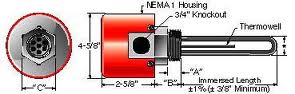
Screw plug immersion heaters consist of tubular elements in a threaded hex plug. Some models are provided with a thermowell for the temperature control sensor and a variety of electrical enclosures for electrical connections. They screw directly through threaded openings in tank walls to heat liquids, viscous fluids, forced air, and gases by direct contact.


Chromalox MT and ARMT series Screw Plug Immersion heaters ( 2-1/2 inch plugs) with copper sheath are available in the below types or styles.

Screw Plug Immersion Heaters can have NEMA 1 housing or general purpose housing for in plant use.
Screw Plug Immersion Heaters can have Moisture resistant housing for wet locations, indoors or outdoors.
Screw Plug Immersion Heaters can have Explosion Resistant housing for hazardous rated areas.

Screw Plug Immersion heaters can also have Thermostats built into the enclosure.  the Thermostats can handle up to 22 AMPS.  If three phase or above 22 amps, a three pole contactor will be required to switch on the heating elements.

Screw Plug heaters with integral thermostat, 0-100 degrees F adjustability.
Screw Plug heaters with integral thermostat, 60-250 degrees F adjustability.

For level control, please go to our level control page here.

For contactors, please go to our contactor page here.

Please visit our immersion heater application data form here and Anderson-Bolds can help pick an immersion heating system for you.

email us at info@anderson-bolds.com

or call us at 216-360-9800


Thursday, May 5, 2011

Watlow Electric Heaters


Watlow Electric Heaters

Cartridge / Insertion Heaters

Watlow’s cartridge heaters and insertion heaters can be inserted into holes, used as immersion heaters placed directly in liquid or in protective wells, or can be mounted in pipes or vessels.Watlow designed and manufactured the first swaged cartridge heater and revolutionized the heating element industry.
With premium materials and tight manufacturing controls, Watlow's cartridge heaters (insertion heaters) provide superior heat transfer, uniform temperatures, resistance to oxidation and corrosion and long life even at high temperatures.


Tubular Heaters


Tubular heaters are used for immersion and air heating applications. They can be clamped to objects such as vessels and tanks, fitted into milled groove platens, immersed directly into a liquid being heated or even mounted in ducts for heating air and gas. Heaters are available as single- and double-ended, and can be formed to complex geometries. Single- and double-ended tubular heaters lend themselves to virtually the entire range of immersion and air heating applications. They have a variety of mounting and termination options that make them ideal for industrial applications. Watlow® tubular heaters are UL® and CSA component recognized up to 240V.

Flexible Heaters

Flexible heaters are commonly used to heat irregular surfaces, shapes and pipes. These heaters can be bonded or fastened to parts and are often used for freeze protection. Flexible heaters from Watlow are thin, bendable and shaped to fit almost any equipment. Heat can be applied to the most complex shapes, geometries, curves and pipes conceivable without sacrificing efficiency or dependability.


Immersion Heaters

These heaters can be immersed directly in the liquid being heated or put in protective wells. Multiple style mounting adaptors are available. Watlow's immersion heaters are designed primarily for direct immersion in liquids such as water, oils, solvents and process solutions, molten materials as well as air and gases. By generating all the heat within the liquid or process, these heaters are virtually 100 percent energy efficient. These versatile heaters can also be formed and shaped into various geometries for radiant heating and contact surface heating applications. UL® and CSA component recognized elements are available.

Circulation Heaters


Watlow’s diverse array of circulation heaters range from quartz heaters for aggressive chemicals to large pressure vessel heaters with capabilities up to 3000psi. These heaters can be used for liquids or gases in various applications. Watlow's circulation heaters are compact heating systems for fluids and gases. These heaters are ideal for applications such as purified and inert gases, supercritical fluids and liquids like de-ionized water for use in semiconductor and electronics industries as well as for general liquid and gas heating applications.


Fluid Delivery Heaters


Watlow fluid delivery heaters provide overall reliable, responsive heating for fluid delivery systems in medical, analytical, water purification and general process applications. Watlow fluid delivery heaters offer precise, repeatable heating, control improving product life. Watlow® innovative fluid delivery heaters produce consistent results by reducing temperature and viscosity variations.

Watlow's syringe heater was developed for the needs of medical injection applications. The special design provides a heated fluid and drug delivery system solution with long operational life which improves system reliability while reducing equipment down time. Watlow's FREEFLEX™ heater unique design places the heating element and sensor directly in contact with the perimeter of the tubing to produce efficient temperature control of the tube contents. The FREEFLEX heater eliminates the need for heated reservoir systems in many applications.


Air Heaters


Watlow’s air heaters can be used to prevent freezing and condensation in electrical and mechanical housing or can be placed in ducts for forced air heating. Watlow has developed a line of process air heaters that offer performance and versatility in medium to low temperature applications. This rugged and reliable line of industrial heaters efficiently conducts heat.


High Temperature Heaters


These high-temperature heaters are used for extreme high temperature applications. The heaters fit applications such as the construction of furnaces and chambers. Watlow leads the industry in developing high-temperature heating technologies and products in various sizes and constructions to fit a broad range of processes and applications. Watlow's MULTICELL™, FIREROD®, tubular and ceramic fiber heaters offer capabilities such as ultra-fast ramp rates, precise temperature uniformity and high temperatures for applications requiring low thermal mass. Heaters are sized and designed to accommodate small to large applications and various environmental conditions.


Specialty Heaters


These specialty heaters are commonly used for high temperature applications or in cases where high watt densities are required. These versatile heating elements can be formed or machined to fit precise heating applications. Watlow specialty heaters are designed for thermal applications where high performance is required, and fast response and uniformity are essential.

Specialty heaters from Watlow have design flexibility to meet different applications requiring different construction methods. This flexibility allows the heaters to be configured in a variety of shapes and sizes depending on the application.


Strip / Clamp-on Heaters


Bolted or clamped to flat surfaces these heaters can provide freeze or moisture protection. These heaters can be attached to tank or vessel walls for warming. Watlow's strip/clamp-on heaters are a versatile solution for a number of applications. They can be bolted or clamped to a solid surface for freeze and moisture protection, food warming and other applications. These heaters make use of the most advanced heat construction techniques.


Band / Barrel Heaters


These heaters can be clamped to most any cylindrical surfaces. The materials used in the construction of these heaters allows them to be used at temperatures up to 1400°F (760°C) or used at low temperatures for freeze protection. Watlow's line of band/barrel heaters are available for fast delivery and can be easily installed into original equipment manufacturer (OEM) and end user applications. This variety of heaters allows the user to specify the construction needed to result in the best heat solution.